
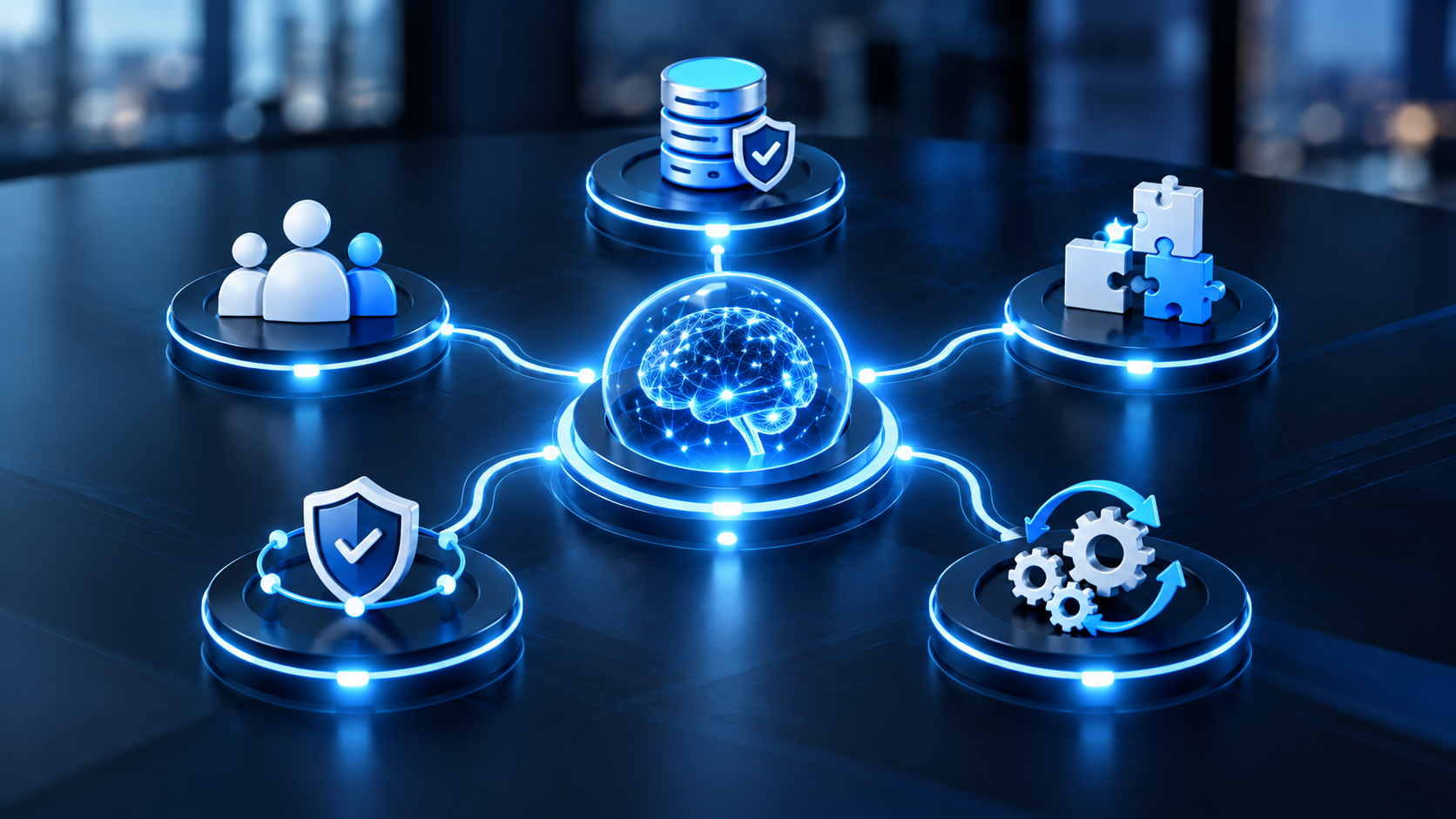
AI readiness is the ability to introduce artificial intelligence deliberately, measure whether it works and govern its impact responsibly. It is not the same as giving every employee access to a chatbot or automating every process.
The conversation has moved beyond AI tools
Businesses can launch AI experiments quickly. Turning those experiments into dependable operational value requires trusted information, clear accountability and well-understood workflows. The newest model does not automatically correct inconsistent records, missing approvals or uncertain permissions.
This distinction is particularly relevant in South Africa, where organisations are balancing modernisation with constraints around costs, skills, security, privacy and legacy systems. Xero’s 2026 survey found that 85% of participating small businesses were prioritising digital adoption, while 56% wanted more support understanding how AI fits their operations. This is survey evidence, not a statement about every South African business. Source: Xero.
Adoption and readiness are different
An organisation may have people using AI for drafting, summarising and research without being ready to allow AI to influence customer-facing processes. Readiness asks harder questions:
- Can the system access accurate, current information?
- Can the relevant business systems exchange that information?
- Does everyone know which information is protected and which tools are approved?
- Who checks an answer or owns an AI-assisted decision?
- Can the organisation measure quality and customer outcomes, not only time saved?
These questions make AI readiness a business-design challenge rather than simply a technology purchase.
The five foundations of an AI-ready organisation

1. Trusted and usable data
If customer records are duplicated, incomplete or inconsistent, AI can produce plausible answers using the wrong context. Identify where important records live, who owns them and what qualifies as the authoritative version. The goal is not necessarily one huge database, but reliable access to relevant information for each use case.
2. Connected systems and workflows
Consider a website enquiry that should reach sales, update the CRM, inform marketing, trigger a follow-up and appear in reporting. If each hand-off is disconnected, AI may make one individual step faster without improving the whole journey. The organisation still relies on manual copying or chasing.
3. Governance and accountability
Employees need clear rules on approved tools, data access, verification, human review and incident reporting. South Africa’s POPIA remains relevant to automated processing of personal information. Section 71 also contains protections around certain solely automated, consequential decisions. Information Regulator guidance provides a starting point. Consult qualified advisers where the use case has regulatory implications.
The NIST AI Risk Management Framework provides a useful voluntary structure for identifying, measuring and managing AI-related risks. It should be adapted to the organisation’s own context rather than treated as a compliance certificate.
4. People and practical capability
Training should go beyond prompt-writing. A marketer, service agent, analyst and developer each need to understand their role’s opportunities, limitations and risks. Teams need to recognise incorrect output, protect confidential information and know when human judgement is necessary.
5. Processes worth improving
Automation can accelerate an ineffective process. Map what happens now: where work begins, who decides, what the exceptions are and what successful completion means. Often the best early improvement is simplifying an approval, improving a form or linking two systems before introducing AI.
Warning signs of poor readiness
Look for enquiries that never reach a CRM, repeated customer details across departments, conflicting status records, unclear opt-out procedures, employees manually reconstructing routine reports, or AI tools accessing sensitive information without rules. These are data and workflow problems before they become AI problems.
A practical route to readiness
- Choose a measurable business problem rather than starting with a tool.
- Map its current process, including exceptions and human hand-offs.
- Identify the minimum trustworthy information needed.
- Correct high-impact data and workflow gaps first.
- Define approved tools, permissions, oversight and monitoring.
- Pilot narrowly against a baseline and measure quality alongside speed.
- Expand only when the results are reliable and the risks are understood.
The OECD report on AI adoption by SMEs highlights factors such as digital maturity, skills and access to enabling infrastructure. It supports the view that organisational foundations matter when turning experiments into business practice.
AI-readiness self-assessment
- We know where our important customer and operational data lives.
- Our teams work from reliable records and relevant interaction history.
- Our priority workflows have clear ownership and can exchange the required information.
- Employees understand which data they may share with AI tools.
- Human oversight is built into consequential decisions.
- We can measure whether each AI use case improves a defined outcome.
If several statements are not yet true, that is not a reason to abandon AI. It is a useful prioritisation list.
Frequently asked questions
What is the first step toward AI readiness?
Identify one business outcome and map the information, people, systems and decisions required to achieve it. Repair critical gaps before deploying AI at scale.
Does a small business need an AI strategy document?
It needs clear choices about use cases, data protection, ownership and measures of success. The documentation may be short, but the decisions should be explicit.
Does AI readiness mean replacing employees?
No. Responsible readiness includes deciding which work benefits from assistance and where human expertise, empathy, approval or accountability must remain central.
Sources and further reading
- Xero: State of South African Small Business 2026
- NIST AI Risk Management Framework
- OECD: AI adoption by small and medium-sized enterprises
- South African Information Regulator
AI readiness is the organisational ability to introduce AI deliberately, learn from evidence and scale only what genuinely works.
Editorial note: This article provides general business information and is not legal advice.